Our rating: On the record. Confirmed by released government records or official investigations. Not a theory any more, though the theories around it may go further than the files do. How we rate.

01 What the theory says
The theory: the U.S. government trained psychic spies who could "see" distant places and hidden objects with their minds, and the program worked well enough that it was hidden, or perhaps never really shut down.
02 Why people believe it
Because the program existed, with real budgets, a real unit at Fort Meade, and real tasking against Soviet targets. Some participants later wrote books describing successes. When the government shut it down and declassified it, believers saw a cover story; skeptics saw confirmation that it never produced anything useful.
03 What's on the record
Each point links to a primary source or official report.
- Starting in the 1970s, U.S. intelligence funded research into "remote viewing," first at the Stanford Research Institute (SRI) and then in a military unit at Fort Meade, Maryland, under a series of code names including Grill Flame, Center Lane, Sun Streak and finally Stargate. (CIA reading room: Stargate collection)
- In 1995 the program was transferred to the CIA, which commissioned an evaluation by the American Institutes for Research (AIR). The review concluded that remote viewing had never been shown to be useful in an intelligence operation, and the program was terminated and declassified. (CIA reading room)
- The two outside experts on that review disagreed: statistician Jessica Utts argued the lab results showed a real effect, while psychologist Ray Hyman argued the findings were not independently replicated and did not prove psychic ability.
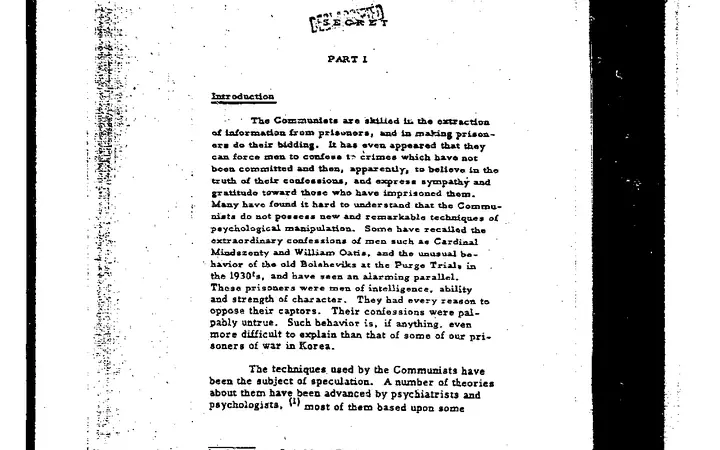
- Thousands of pages of Stargate documents, including session transcripts, are now in the CIA's online reading room. (CIA reading room)
04 What's unproven or disputed
- That remote viewing works. No independently replicated scientific evidence shows it does, and the 1995 review found no operational value.
- That the program secretly continued. No released record shows that, though it's a popular claim.
- Specific dramatic "hits" described in participants' memoirs. Some sessions are cited as striking, but judging them depends on how vague the descriptions were and how they were matched to targets.
05 Open questions
- Why did funding survive for two decades if results were so weak?
- How were sessions scored, and could feedback have biased them?
- Did other countries run similar programs, and what happened to theirs?