Our rating: On the record. Confirmed by released government records or official investigations. Not a theory any more, though the theories around it may go further than the files do. How we rate.
01 What the theory says
The claim: the U.S. government deliberately withheld treatment from Black men with syphilis for decades so it could study the disease, and lied to them about what was happening.
02 Why people believe it
Because it's true and officially acknowledged, including by a sitting President. The study is the reason this entry sits on a conspiracy site at all: it's the real case people point to when they say "they've done it before." That doesn't make other claims true, but it explains why trust has to be earned.
03 What's on the record
Each point links to a primary source or official report.
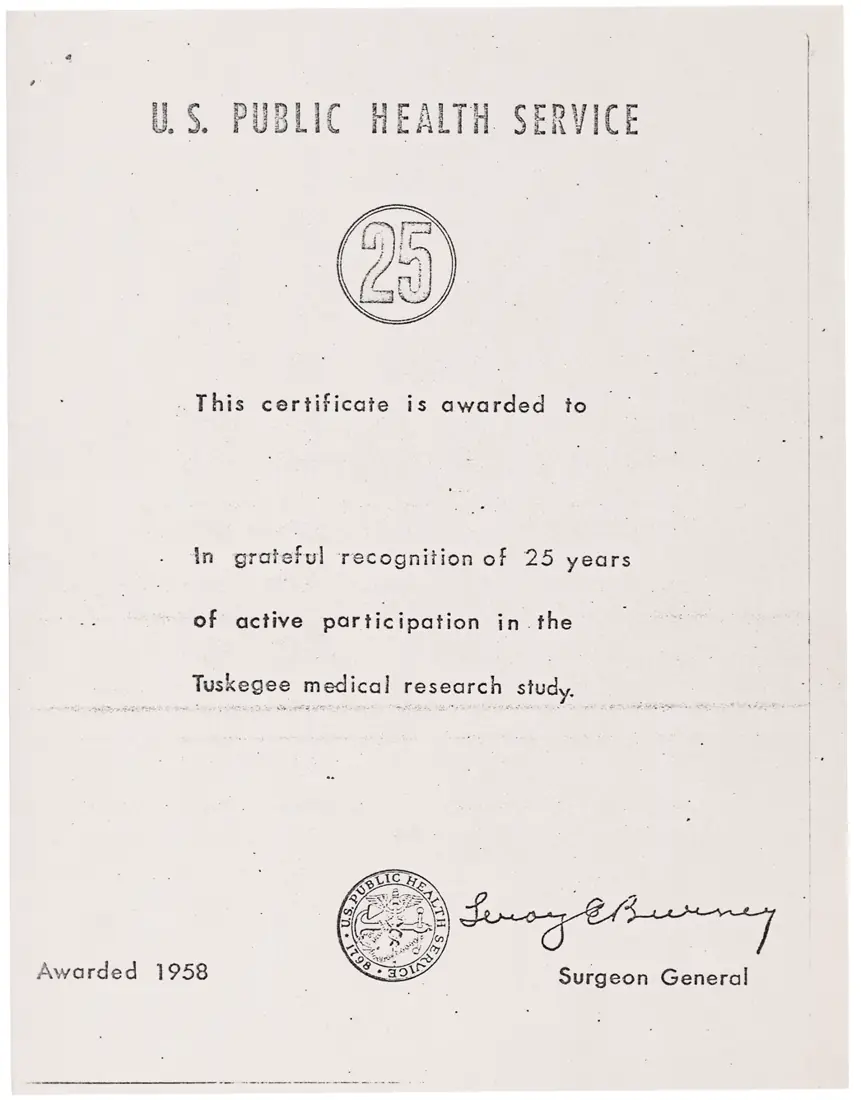
- The U.S. Public Health Service ran the "Tuskegee Study of Untreated Syphilis in the Negro Male" from 1932 to 1972 in Macon County, Alabama. It enrolled 600 Black men: 399 with latent syphilis and 201 without the disease as controls. (CDC)
- The men were not told they had syphilis or asked for informed consent. They were told they were being treated for "bad blood." By 1947 penicillin had become the standard treatment, but they were not offered it. (CDC)
- The study ended in 1972 after Public Health Service employee Peter Buxtun, who had raised concerns internally in the 1960s, took the story to the press. A 1974 class-action settlement paid $10 million, and the government set up a health benefits program for survivors and their families. (CDC; National Archives records)
- On May 16, 1997, President Bill Clinton formally apologized on behalf of the nation. (White House remarks, archived)
04 What's unproven or disputed
- That the men were deliberately infected with syphilis. This is a widespread belief, but the Tuskegee men already had the disease when they were enrolled. (A separate U.S. study in Guatemala in the 1940s did deliberately infect people; it's a different case.)
- Using Tuskegee as proof of a current medical claim. The study shows real past wrongdoing. It isn't evidence about any specific modern medicine or vaccine; those have to be judged on their own data.
05 Open questions
- How many wives and children were infected because the men went untreated?
- Why did the study survive so many internal reviews before 1972?
- What did the rules for informed consent that came out of it change, and what loopholes remain?